Scientific American Frontiers: Episode list
In the episode entitled, "Sci-Fly", Scientific American Frontiers comes to the Georgia Institute of Technology to film the International Aerial Robotics Competition and its creator, Prof. Robert C. Michelson during its inaugural year. The competition involved fully autonomous aerial robots attempting to complete a complex task without human intervention.
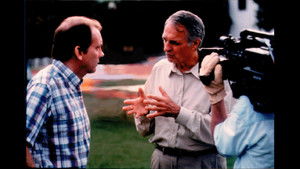
In the episode entitled, "Flying High" (Robo Flyers segment), Alan Alda travels to the Georgia Institute of Technology to film the International Aerial Robotics Competition and to interview its creator, Prof. Robert C. Michelson.
Some of the nations top neuroscientists uncover new evidence of our brain's ability to change.
Discover the science behind people who push themselves to the limits of human performance.
How did life arise on Earth? What separates humans from apes? Will machines one day invent themselves? Learn more here.
Learn about advances in the repair and replacement of the hard-working heart.
Why can't you tickle yourself? Is laughter uniquely human? These little questions might have some big answers.
Alan Alda learns that sometimes saving endangered species requires restoring whole ecosystems.
Researchers are uniting biology and technology to give hope to the paralyzed.
Get to know chimpanzees, how they socialize with each other, new dangers they face, and just how similar our species truly are.
Join aviation engineer Paul MacCready and Alan Alda as they test fly a variety of unconventional planes.
Alan Alda explores the real science behind fad foods, eating habits and lifestyles.
Scientists reconstruct past events from evidence of excavated remains.
Medical treatments for children with physical disabilities.
Science and technology improves on sports.
New technologies and research techniques, some from the work of pioneer oceanographer Robert Ballard, open up the oceans' depths to humans.
Science and engineering students participate in a design contest, an aerial robot contest, a human powered submarine race and robot soccer games.
“Coming into America” explores how prehistoric immigrants (host Alan Alda calls them “the true American pioneers”) might have arrived here---up to 20,000 years ago. Conventional wisdom has been that the “Clovis people” made their way down from Siberia about 13,000 years ago and spread out. But archaeologists interviewed point to artifacts in various places around the U.S. that are far older---and there's evidence that the ice sheets remained in place longer than previously thought---casting doubt on that theory.